A recent article from Tria about "Unchained Intelligence" suggests that new technology—integrating AI Agents to handle this chaos—might just create the "Best Crypto Card Ever.
If you’ve ever tried using Crypto in real life, you know it can feel like a game of "musical chairs." You have to check which chain your funds are on, worry about gas fees, or transfer assets to an exchange first... This mess is exactly why Crypto hasn't reached "Mass Adoption" yet.
But today, we are standing at a major turning point. A recent article from Tria about "Unchained Intelligence" suggests that new technology—integrating AI Agents to handle this chaos—might just create the "Best Crypto Card Ever."
To understand why this is such a game-changer, let's take a quick look back at how we got here.
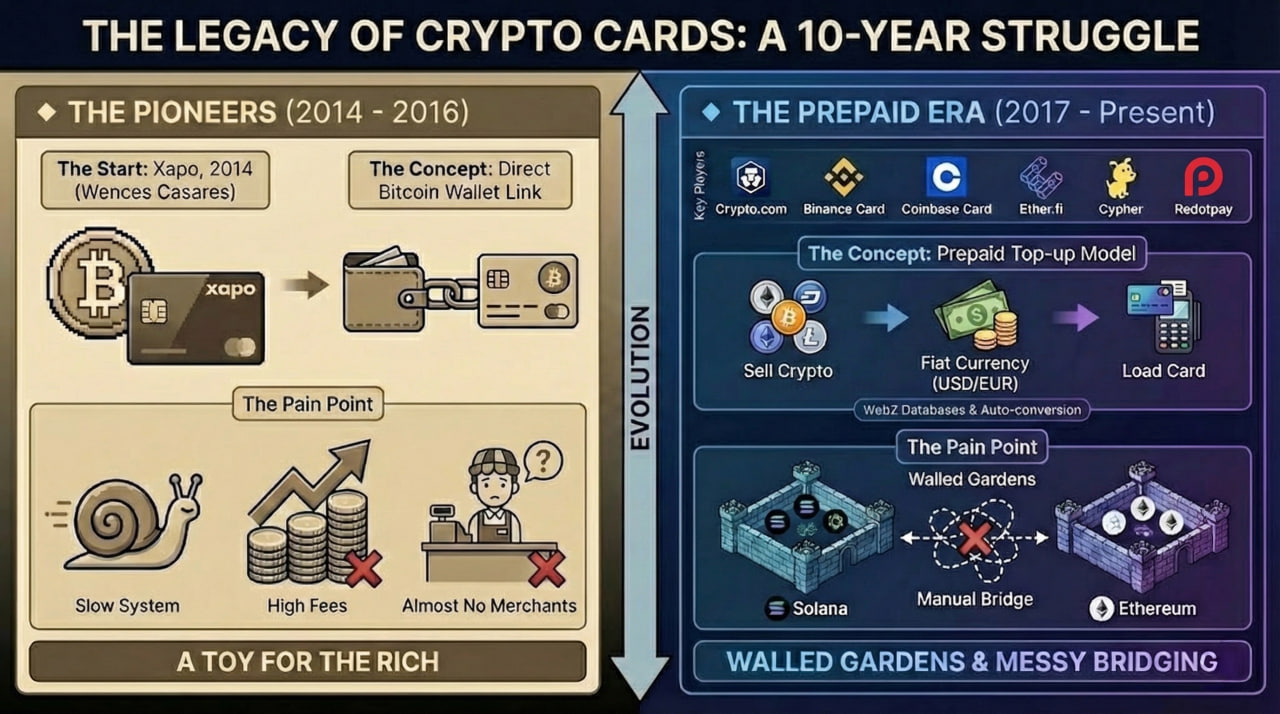
📜 1. The Legacy of Crypto Cards: A 10-Year Struggle
The dream of buying coffee with Bitcoin isn't new; it has evolved over a long time:
🔹 The Pioneers (2014 - 2016)
The Start: It began around 2014 with legends like Xapo (founded by Wences Casares).
The Concept: One of the first Bitcoin debit cards directly linked to a wallet.
The Pain Point: Back then, the system was slow, fees were incredibly high, and almost no merchants recognized Bitcoin. It was more of a "toy for the rich" than a daily tool.
🔹 The Prepaid Era (2017 - Present)
Key Players: Crypto.com, Binance Card, Coinbase Card, Etherfi , Cypher, Redotpay
The Concept: Mostly a "Prepaid Top-up" model. You have to "sell" your Crypto for Fiat currency (USD/EUR) to load the card before swiping. While some offer auto-conversion, they still rely heavily on Web2 databases.
The Pain Point: The biggest problem is "Walled Gardens." Have money on Solana, but the card only supports Ethereum? Too bad! You have to bridge the tokens yourself—a messy, multi-step process.
The real issue with the Prepaid era isn't just the inconvenience; it's about "Capital Efficiency." Selling your Crypto for Fiat and leaving it idle on a card means you incur an Opportunity Cost if the asset price surges during that time.
Furthermore, the traditional model is largely Custodial, which directly contradicts the core ethos of "Not your keys, not your coins." If Tria can solve this non-custodial aspect, it is intriguing.
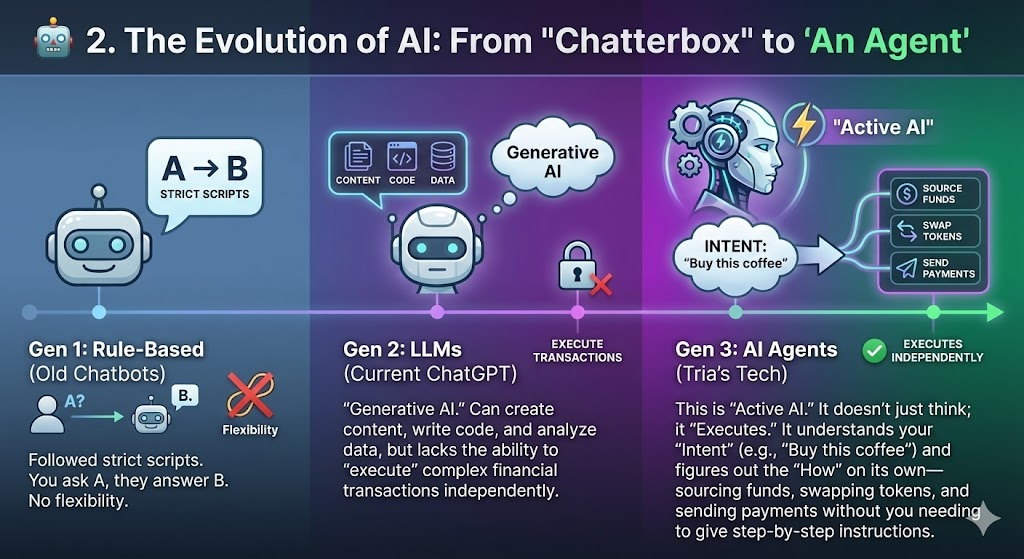
🤖 2. The Evolution of AI: From "Chatterbox" to "An Agent”
While the financial world was trying to fix payments, AI was growing in parallel. This is the key to Tria’s innovation:
Gen 1: Rule-Based (Old Chatbots): Followed strict scripts. You ask A, they answer B. No flexibility.
Gen 2: LLMs (Current ChatGPT): "Generative AI." Can create content, write code, and analyze data, but lacks the ability to "execute" complex financial transactions independently.
Gen 3: AI Agents (Tria's Tech): This is "Active AI." It doesn't just think; it "Executes." It understands your "Intent" (e.g., "Buy this coffee") and figures out the "How" on its own—sourcing funds, swapping tokens, and sending payments without you needing to give step-by-step instructions.
Technically, what Tria is doing might be closer to an advanced "Smart Router" or "Solver" (similar to 1inch or CowSwap), programmed to find the best algorithmic route, rather than an AI that effectively "thinks" like a human.
Whatever, Is it good because it reduces human error and time spent on transactions.
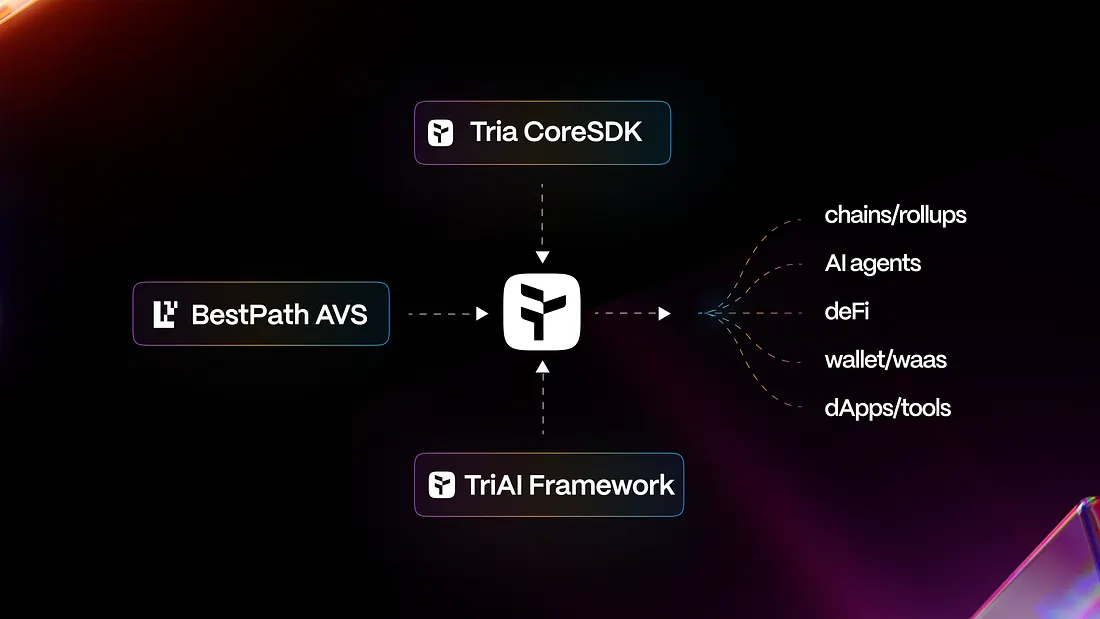
🧠 3. Tria & Unchained Intelligence: Behind the Magic
Tria isn't just launching another card; they are building new Infrastructure called "Unchained Intelligence," powered by a system known as BestPath AVS.
Let's break down this complex system into a friendly, user-centric explanation:
🛠 How the Tria AI Agent Works
When you tap your card to pay, this is what happens in the background in milliseconds:
Liquidity Aggregation: Normally, your funds are scattered (USDC on Arbitrum, USDT on Polygon, ETH on Base). Tria’s system sees all of this as "One Wallet."
BestPath Routing: The AI immediately calculates: "Which chain should I pull funds from to get the lowest fees and fastest speed?" using AVS (Actively Validated Services) technology.
Auto-Bridging & Swapping: The AI manages bridging across chains and swapping tokens automatically. You won't even know it happened.
At The Moment none of Crypto Card use Tech like this. Everyone else is just polishing the same old 'Top-Up' model. Tria is trying to change the game.

✨ 4. Why Call It the "Best Crypto Card Ever"?
Compared to legacy cards, Tria solves the most annoying pain points:
✅ Chain Abstraction (Limitless)
Old Way: You had to move tokens to the specific chain the card supported.
New Way: Your funds can be on any chain in the Web3 universe. The system connects them for you. You just need to "have money."
✅ Universal Gas (Forget Gas Fees)
Old Way: You want to pay with USDC, but your wallet has no ETH for gas... Transaction Failed!
New Way: Tria pays the gas for you (Paymaster) and deducts it from the token you are spending, or uses any token for gas. The experience is as seamless as a bank app.
✅ True Non-Custodial (You Own Your Money)
Old Way: You have to deposit funds into the provider's wallet (risky, remember FTX?).
New Way: You hold your own Private Keys (Self-Custody). The money remains under your control until the exact moment you tap to pay.
This is makes people using crypto cards seemless and smoother.
Conclusion: We are entering an era of “Invisible Tech”
This article highlights that the next era of Crypto isn't about users learning how to use Bridges or memorizing chain names.
It is the era of "Abstraction"—simplicity that hides complexity.
New Users: Only need to know, "I have digital money, and I can buy things." Done.
AI Agents: Act as personal managers, running all the backend logistics.
If Tria can deliver on this roadmap, this won't be just another crypto card. It will be the strongest "Bridge" to finally bring everyday people into the world of Web3.
But in reality, there are about hidden swap fees (Slippage). If the tech holds up, it’s a winner. If not? It's just another cool idea that didn't work.
JOIN : https://app.tria.so/?accessCode=GQ41753785
Disclaimer : This content is for informational purposes only and is not investment advice. DYOR.